The Anxious-Avoidant Attachment Trap
One leans in, the other pulls away. How the pursue-withdraw cycle forms when anxious and avoidant styles collide, and how couples actually break it.
By QuizCupid Editorial TeamSeptember 3, 20265 min read
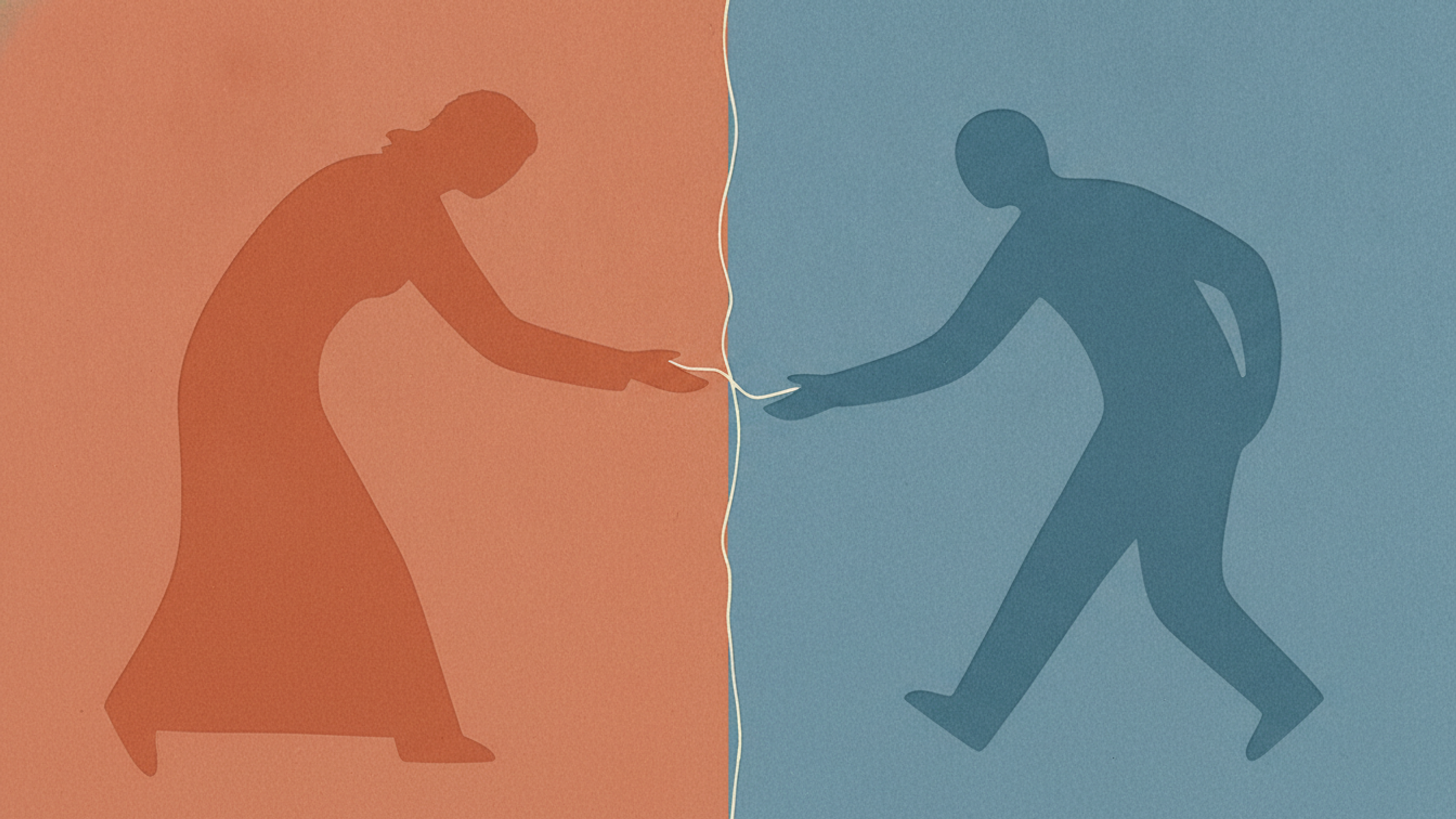
When a text goes unanswered for five minutes, your stomach drops and you check your phone over and over. Your partner does the opposite: the closer you try to get, the more they pull back, and the moment a conversation turns emotional, they go quiet or change the subject. It can feel like random incompatibility, but you're actually inside a pattern psychology has described for decades: the self-feeding loop that forms when anxious and avoidant attachment styles end up together.
All of us, from the cradle to the grave, are happiest when life is organized as a series of excursions, long or short, from the secure base provided by our attachment figures.
What Happens When Anxious and Avoidant Attachment Collide?
Someone with anxious attachment reads any dip in closeness as a threat; they seek reassurance, call, text, ask for explanations. Someone with avoidant attachment experiences the opposite: as closeness increases, they feel boxed in and need space. Held up against Bowlby's idea of a "secure base" above, both are actually missing the same thing in different ways: for the anxious partner, the relationship never quite feels safe because the fear of losing it is always switched on; for the avoidant partner, closeness itself doesn't register as a secure base, it registers as a threat to their independence.
Why Are They So Drawn to Each Other?
Strange as it looks from the outside, this pairing is extremely common, because each person finds a mirror of their own inner conflict in the other. For the anxious partner, winning over a distant partner can feel like finally earning the reassurance they crave, which loads the relationship with intense meaning; for the avoidant partner, a partner who never gives up can feel like the only kind of closeness they'd never seek out on their own. The pull isn't coming from healthy compatibility, it's coming from intermittent reinforcement, the same on-again-off-again pattern behavioral psychology recognizes as one of the most addictive reward schedules there is; unpredictability can feel more magnetic than predictable closeness ever does.
How the Pursue-Withdraw Cycle Actually Works
Psychologists Mario Mikulincer and Phillip Shaver, in Attachment in Adulthood (2007), show that under threat these two styles reach for opposite strategies: the anxious partner shifts into "hyperactivation," amplifying the emotion, pressing for attention, calling, asking; the avoidant partner shifts into "deactivation," suppressing the need, creating distance, avoiding anything that sounds like an emotional conversation. One gets louder while the other goes quiet, which pushes the first to try even harder to be heard and the second to retreat even further. Couples therapy literature usually calls this the pursue-withdraw cycle, and it sits at the center of the Emotionally Focused Therapy model developed by Sue Johnson.
The Moments That Set the Cycle Off
The triggers are usually small and repetitive: a late reply, a vague weekend plan, the feeling that one person is putting in more effort than the other. Psychologist Andrew Christensen's research on marital conflict found that during an argument, one partner tends toward pushing to talk it through (the "demanding" role) while the other tends toward pulling away from the topic (the "withdrawing" role), a pattern that repeats across many couples regardless of what the actual fight is about. In anxious-avoidant pairings, these roles almost always land the same way, which is why arguments can feel like the same scene replaying no matter what started it.
What Actually Breaks the Cycle
The first step is noticing the pattern itself instead of the argument's content, once either person can say "we're doing the thing again," the fight is pointed at a shared pattern instead of at each other. For the avoidant partner, a framework that helps is separating asking for space from disappearing: "I can't talk about this right now, but let's talk tomorrow morning" offers a very different kind of reassurance than going silent without a word. For the anxious partner, naming the need directly instead of as an accusation helps just as much: "I need some reassurance right now" lands very differently than "are you leaving me," and doesn't put the other person on the defensive. Both sides have to practice doing the opposite of their old reflex, insisting or disappearing, in small deliberate steps.
When to Get Professional Support
Awareness and better communication are enough for a lot of couples, but if the cycle has been stuck in the same place for years, or if either person feels chronically unsafe, professional support is a reasonable next step. Sue Johnson's Emotionally Focused Therapy was built specifically to target this exact cycle: the goal isn't deciding who's right, it's helping both people make the fear underneath the surface behavior, abandonment on one side, being overwhelmed on the other, visible to each other.
Frequently Asked Questions
Can anxious-avoidant couples ever be happy? Yes, but usually not by accident, it takes deliberate effort. Couples who recognize and name the cycle tend to respond to the same triggers faster and with far less damage.
Is attachment style fixed for life? No. The concept of "earned security," which Mikulincer and Shaver also discuss, shows that someone who developed an insecure style in childhood can still move toward a more secure style over time through a stable, consistent relationship or therapy in adulthood.
Does only the avoidant partner need to change? No, since the cycle is something both people produce together, the change has to come from both sides: the avoidant partner has to learn to ask for space without disappearing, and the anxious partner has to learn to ask for reassurance without pressing. If one changes and the other stays in their old role, the cycle just shifts direction, it doesn't disappear.
The anxious-avoidant cycle is really just two different fears getting triggered at the same time, one person afraid of being left, the other afraid of being swallowed. Both feel justified from where they're standing, which is exactly why the cycle breaks through naming it together, not through blame. In your next disagreement, looking at which old role you've slipped into, rather than what the argument is technically about, is usually the fastest way out.
More in Psychology
All posts 🧠 Psychology
What to Do After You've Been Ghosted
Ghosting is hard to recover from precisely because it leaves no explanation. Here is why it hurts so much and how to give yourself closure.
 🧠 Psychology
Personal Space in a Relationship: The Need to Be Alone
Loving your partner and wanting time alone are not in conflict. Here is why personal space is a need, and how to talk about it without guilt.
 🧠 Psychology
What Is Love Bombing, and How Do You Recognize It?
Overwhelming attention in a relationship's early weeks is sometimes real connection, sometimes a manipulation pattern called love bombing.
More Posts
- Love or Obsession? What the Film 'Obsession' Really Shows
- The Difference Between Healthy Jealousy and Harmful Jealousy
- How Depression Affects Relationships
- Love Language Lessons From Anime Characters
- How Social Media Changed Relationships
- Types of Love Quizzes: 4 Kinds and When Each Fits
- What Are Attachment Styles and How Do They Shape Love?
- What Is a Love Language, and How Do You Discover Yours?
Try a Test
All testsPlayful tests to help you discover yourself and your relationship.
- Relationship Fit TestQuestions on communication, trust, and shared time measure how in sync your relationship really is.
- 5 Love LanguagesBased on Gary Chapman's 5 love languages, discover how you express love and what your partner truly needs.
- Love TestAnswer a few short questions about your everyday choices, find your love score, and share it with friends.