What Odysseus and Penelope Teach Us About Relationships
As Nolan's 'The Odyssey' breaks box office records, we look at what Homer's 3,000-year-old epic still gets right about separation, uncertainty, and trust.
By QuizCupid Editorial TeamSeptember 4, 20265 min read
Contents7
- 01Why Odysseus, Why Now?
- 02Penelope's Twenty Years: What Is 'Ambiguous Loss'?
- 03Odysseus's Return: Coming Home Isn't the Same as Coming Back
- 04The Loyalty Test: Penelope's Weaving Trick
- 05The Recognition Scene: How Trust Actually Gets Rebuilt
- 06From Myth to Now: What Long Separations Have in Common
- 07Frequently Asked Questions
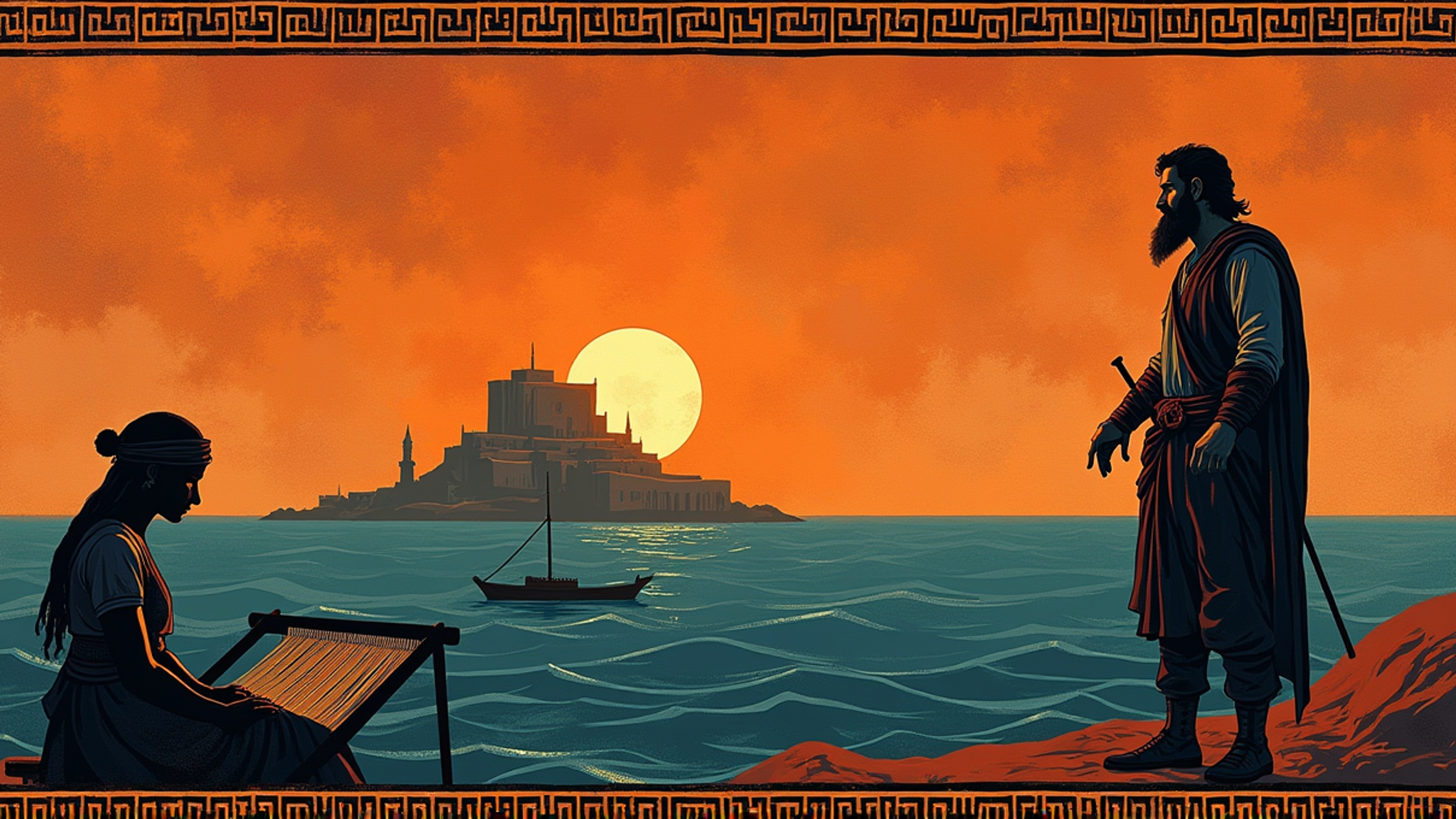
With Christopher Nolan's record-breaking film 'The Odyssey' in theaters, Homer's 3,000-year-old epic is suddenly everywhere again. But the story isn't just about war, sea monsters, and gods; at its center is a twenty-year separation between two people. Odysseus's journey home from Troy takes ten years, but the twenty years Penelope spends in Ithaca (ten years of war plus ten years of his journey back) are a whole different story, one rarely told from her side.
Her face was melting, like the snow that Zephyr scatters across the mountain peaks; then Eurus thaws it, and as it melts, the rivers swell and flow again. So were her lovely cheeks dissolved with tears. She wept for her own husband, who was right next to her.
Why Odysseus, Why Now?
Nolan's film may sell the story through scale and action, but that's not why the Odyssey has survived for millennia. The epic is really about what happens when people are cut off from each other for a very long time, how that separation changes both of them, and why coming back together never simply means going back to how things were. For anyone living through a long-distance relationship, a deployment, a prison sentence, or a long illness that's kept them apart from someone, this 3,000-year-old story reads as strangely familiar.
Penelope's Twenty Years: What Is 'Ambiguous Loss'?
There's a concept in psychology that describes Penelope's situation almost exactly: ambiguous loss. Therapist and researcher Pauline Boss coined the term in her 1999 book "Ambiguous Loss: Learning to Live with Unresolved Grief," describing situations where someone is physically gone but there's no confirmed loss, like families of soldiers missing in action, or relatives of people with Alzheimer's. Penelope is in exactly that position: she doesn't know if her husband is dead or alive, she can't grieve because there's no confirmed loss, and she can't move on because the uncertainty never resolves. Boss's research found that this kind of ambiguity can be even harder to live with than a clear loss, because the mind never gets closure, it just keeps swinging between hope and despair.
Odysseus's Return: Coming Home Isn't the Same as Coming Back
When Odysseus reaches Ithaca, no one recognizes him, partly because his appearance has changed, but mostly because what he lived through in Troy and on the journey home has made him a different person. He enters his own home disguised as a beggar and reveals his identity to no one at first. That's not just a plot device: someone who returns after a long separation is often not the person who left. Someone coming back from war, illness, or prolonged isolation can become emotionally unrecognizable, and the person waiting for them sometimes sees the familiar body before they notice the change underneath it. Rebuilding a relationship after that means getting to know the new version of each other, not waiting for the old one to come back.
The Loyalty Test: Penelope's Weaving Trick
It's easy to picture Penelope as passively waiting, but in the epic she is anything but passive. She tells her suitors she'll choose one of them once she finishes weaving a burial shroud for her father-in-law, then secretly unravels it every night so the work never finishes, stalling 108 suitors for years. That detail matters: loyalty here isn't just "doing nothing and waiting," it's Penelope actively buying time and holding on to control over her own future instead of simply accepting her circumstances. Loyalty in real relationships often works the same way, what looks from the outside like passive faithfulness is usually made of a lot of small, active choices from the inside.
The Recognition Scene: How Trust Actually Gets Rebuilt
When Odysseus finally returns, Penelope doesn't accept him right away, she tests him instead. She tells a servant to move their marriage bed out of the room. Odysseus reacts with outrage, because he built that bed himself around the trunk of a living olive tree still rooted in the ground, it can't be moved without cutting the tree down. Only the real Odysseus could know that. That's the moment Penelope actually recognizes him, not through declarations, but through a small, shared, verifiable fact that only the two of them know. Rebuilding trust after a long separation tends to work the same way in real life, not through abstract promises, but through small, checkable details that prove a shared history is real.
From Myth to Now: What Long Separations Have in Common
The story of Penelope and Odysseus shares its basic structure with a lot of modern situations: families of MIA soldiers, long medical treatments, prison sentences, long-distance relationships, all involve a physical or emotional absence, a lack of certain information, and the effort of building a life inside that gap. Boss's research found that people who cope well with these situations share one thing in common: instead of ignoring the uncertainty or being consumed by it, they learn to hold both hope and possible loss at the same time. The real question isn't "when should I give up," it's "how do I keep living while this stays unresolved."
Frequently Asked Questions
Did Odysseus's journey really take twenty years? Yes: the Trojan War lasted ten years, and his journey home afterward took another ten. Penelope waited that entire time without knowing what had happened to him.
Was Penelope really faithful, or did she just have no other choice? In the epic, 108 suitors want to marry her, and turning them all down isn't easy, the social and financial pressure is real. It's more accurate to read her loyalty as years of active resistance than as a passive default.
Is the only lesson here "stay loyal"? No. The real point is how two people, changed by a long separation from each other, manage to reconnect at all, loyalty is only one part of that.
The Odyssey has probably survived this long not because of the sword fights, but because it describes separation, uncertainty, and reunion in language that still doesn't feel that far from ours, three thousand years later. Nolan's film may take audiences to war, but the heart of the story always stayed in Ithaca, in that house waiting for a return.
More in Relationships
All posts 💞 Relationships
What Is Micro-Cheating, and Where Is the Line?
Secretly liking a photo, messages with an ex that get personal. Not classic cheating, but not innocent either. Where the micro-cheating line sits.
 💞 Relationships
How to Apologize Effectively (and Actually Repair It)
Most "I'm sorry"s aren't real apologies, just a quick way to end an argument. Here's what an apology that actually works looks like.
 💞 Relationships
What Is a Situationship? How It Differs From a Relationship
Not quite friends, not quite a couple. Here's what a situationship actually is, why it's suddenly everywhere, and how to tell where yours is heading.
More Posts
- The Money Talk: When and How to Have It as a Couple
- Closing the Distance: Why Reuniting Is Harder Than You Think
- 25 Questions to Keep the Conversation Going on a First Date
- Relationship Lessons From Fictional Couples on Screen
- The Best Apps to Meet People: A 2026 Guide
- 7 Signs You and Your Partner Are Actually Compatible
- How to Read Your Partner's Love Language: 5 Everyday Clues
- How to Build Trust in a Relationship: 6 Practical Steps
- 5 Golden Rules of Healthy Communication in Relationships
Try a Test
All testsPlayful tests to help you discover yourself and your relationship.
- Relationship Fit TestQuestions on communication, trust, and shared time measure how in sync your relationship really is.
- Which Love Character Are You?Playful questions about how you act when you're in love reveal the love character that fits you best.
- Which Romance Movie Are You?Answer questions about your outlook on love to find the romantic film that tells your story best.